Brake testing is a critical component of heavy vehicle compliance inspections
(COF B), entry certification, and workshop diagnostics. While modern roller brake testing machines (RBM) are highly accurate, their results are only as reliable as the conditions under which the test is performed. One of the most commonly overlooked variables is vehicle load. This is where load simulation plays a vital role, ensuring brake performance is assessed under realistic, repeatable, and compliant conditions.
The New Zealand Heavy Vehicle Brake Test Protocol was revised and updated on the first of December 2022 to ensure consistent testing using approved RBM’s at NZTA approved inspection sites country wide.
This protocol sets the standard for all compliance and enforcement brake testing for heavy vehicles (COF B) in New Zealand.
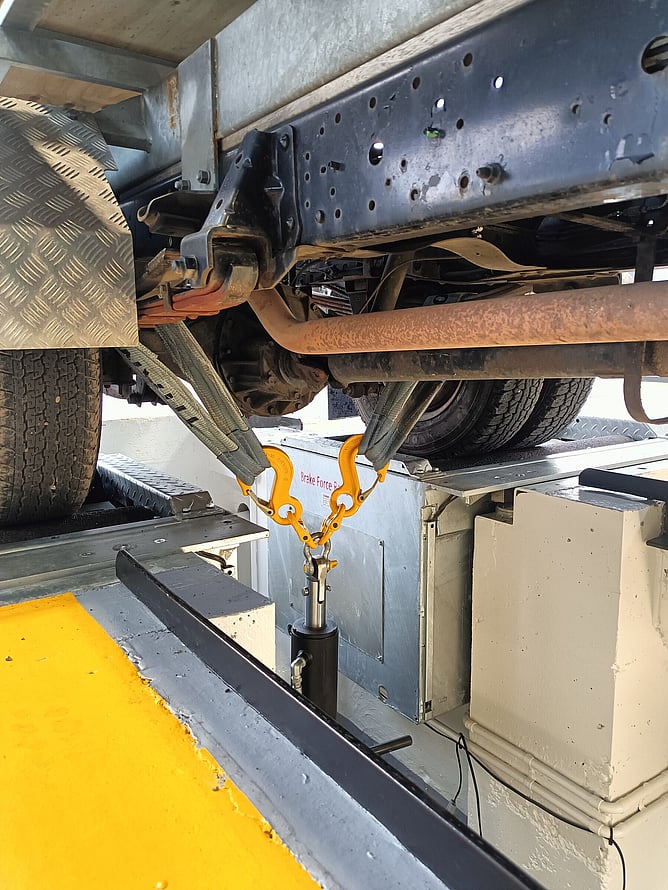
Photo below is a recent installation AECS Equipment designed for a client in Christchurch
Why Vehicle Load Matters in Brake Testing
Braking performance is directly influenced by axle load. Factors such as:
Brake force generation
Wheel slip characteristics
Brake balance between axles
ABS and EBD system behaviour
all change significantly depending on how much weight is applied to the vehicle.
Testing a lightly loaded vehicle—particularly vans, utes, SUVs, and light commercial vehicles—can result in:
Reduced brake force readings
Premature wheel lock-up
Inaccurate imbalance measurements
False failures or misleading pass results
In real-world operation, these vehicles often run close to Gross Vehicle Mass (GVM), meaning an unloaded brake test does not accurately reflect on-road performance.
What Is a Load Simulation Lift Kit? (LSK)
An LSK is an independent system that accompanies an RBM, usually floor mounted in the pit, that applies controlled vertical downward force to the vehicle axles during testing. This simulated load replicates the effect of carrying passengers, cargo, or equipment without otherwise loading the vehicle for a test.
The formula for implementing correct load simulation in New Zealand is that an LSK must be able to simulate a minimum of 65% of the maximum axle weight of the RBM it is used with.
In conjunction with the RBM weight scales, a quick calculation using GVM can ensure the result is a consistent, repeatable axle load applied during every test.
There are two distinctly different types of LSK depending on the RBM used.
1/ Hydraulic pull down LSK for standard non lift bed RBM’s
2/ Static LSK for RBMs with built in lifting roller sets
Key Technical Benefits
1. Accurate Brake Force Measurement
By increasing tyre-to-roller contact force, load simulation allows the brakes to develop their true braking potential. This results in:
Higher, more realistic brake force readings
Improved repeatability between tests
Reduced test variability between operators
2. Correct Assessment of Brake Balance
Front-to-rear and left-to-right brake balance can only be accurately measured when the vehicle is operating under representative load conditions. Load simulation helps prevent:
False imbalance readings
Misdiagnosis of otherwise serviceable brake systems
3. Improved brake force distribution and stability system evaluation, modern vehicles rely heavily on electronic braking aids. These systems are load-sensitive and may behave differently when a vehicle is unladen. Therefore load simulation:
Provides more accurate EBD behaviour during testing
Vehicles tested at CoF B or at Compliance inspection intervals using a load simulation kit helps businesses:
Meet inspection authority expectations
Reduce re-test rates
Defend test results during audits
Workshop efficiency and safety from an operational standpoint.
Workshop Efficiency and Safety
From an operational standpoint, load simulation lift kits eliminate the need for:
Manually loading vehicles with ballast
Using unsafe or improvised weights
Relying on inconsistent test setups
This improves:
Test speed
Operator safety
Equipment longevity
Conclusion
Load simulation lift kits are not an optional accessory—they are a critical component of accurate, compliant, and professional brake testing. By replicating real-world operating conditions, they ensure brake performance is measured as it should be: under load.
For workshops investing in modern brake testing equipment, incorporating load simulation is a future-proof decision that improves diagnostic accuracy, compliance confidence, and overall test credibility.