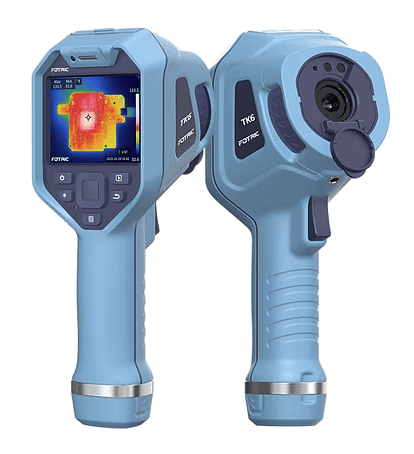
Thermal imaging used to be industrial equipment with an industrial price. Now there's a version of it clipped to a phone for a couple of hundred dollars, and every workshop has someone who's tried one.
Which has left a genuinely confusing situation. Thermal imaging is one of the most useful diagnostic techniques available to a modern workshop — and most of the cameras being sold into workshops right now aren't good enough to do it properly. Both of those things are true at once.
Here's what the technique actually finds, what the numbers on the spec sheet mean, and what separates a diagnostic instrument from an expensive novelty.
What thermal imaging is really doing
A thermal camera measures infrared radiation and turns it into a temperature reading for every point in its field of view. That's it. It isn't x-ray, it isn't magic, and it doesn't see inside anything.
But almost every fault in a vehicle either produces heat or fails to. Electrical resistance makes heat. Friction makes heat. Combustion makes heat. Blocked flow means heat doesn't get where it should. Once you can see temperature across a whole component at once, instead of poking at it one point at a time with a probe, a lot of hard diagnostic work becomes fast and obvious.
The other half of the value has nothing to do with diagnosis. A thermal image of a glowing-hot battery terminal or a brake rotor that's four hundred degrees hotter than the one on the other side is the single most persuasive thing you can put in front of a customer. It ends the conversation about whether the work is necessary.
What it finds on a vehicle
Engine and combustion. Scan the exhaust manifold with the engine running and each runner tells you how well its cylinder is burning. A cylinder that's misfiring runs cooler than its neighbours, often before the code sets. Compare a catalytic converter's inlet and outlet temperature and you know whether it's still doing its job. Exhaust leaks show up as a hot plume at the joint.
Brakes and running gear. Road test the car and look at all four corners. A dragging brake or a seized caliper is instant. So is a brake imbalance across an axle, and so is a wheel bearing that's on its way out — bearings run hot well before they get noisy enough for a customer to book in.
Cooling and climate. A blocked radiator core shows the coolant flow pattern across its face, cold patches and all. Thermostats, heater matrices and A/C systems all become visible processes rather than a series of guesses. The "no heat on the passenger side" job goes from an afternoon to about ninety seconds.
Electrical. This is where thermal earns its keep. Resistance makes heat, so every bad earth, corroded terminal, undersized repair and failing relay warms up under load. You can scan an entire fuse box in one image instead of probing every circuit.
EV and hybrid. Battery pack thermal balance, charging connectors under load, inverters, DC-DC converters, motors. All non-contact, which on a high-voltage system stops being a convenience and starts being the whole point.
Now the part that decides whether yours will work
Three numbers matter. Most cheap cameras fail on all three, and the marketing is built around hiding it.
1. Real resolution, not interpolated resolution
A thermal sensor is a grid of individual detectors. A 384×288 sensor has 110,592 of them, each one measuring the temperature of its own small patch of the world. More detectors means more real information.
The trick to watch for: many budget cameras quote a large resolution that their sensor does not have. A small sensor — sometimes as little as 80×60 — is upscaled by software, with the missing pixels invented by interpolating between the real ones. The resulting image is smoother and larger and contains not one extra piece of information about the vehicle.
What to ask: what is the native detector resolution? If the answer is vague, or the spec sheet says "enhanced", "super resolution" or gives you an output image size instead of a sensor size, you have your answer.2. Focus — the one nobody mentions
Most low-cost thermal cameras are fixed focus. This sounds like a minor convenience issue. It isn't.
An out-of-focus thermal image doesn't just look soft — it reads the wrong temperature. Heat from the surrounding area blends into whatever you're trying to measure, so a small hot spot gets averaged with the cooler metal around it and reads too cool. The camera will give you a confident number that is simply wrong, with no indication anything is amiss.
For scanning a wall, fixed focus is fine. For comparing six exhaust runners, checking one terminal in a crowded junction box, or measuring a single cell group in a battery pack, it's the difference between a diagnosis and a picture.
What to ask: does it have a real focus mechanism? Manual focus is fine — arguably better than autofocus, because you control it.3. Thermal sensitivity (NETD)
NETD is the smallest temperature difference the camera can tell apart, quoted in millikelvin. Lower is better. A good professional camera is around 40 mK, meaning it resolves four hundredths of a degree.
This matters because almost all automotive thermal work is comparative. You're rarely asking "how hot is this" — you're asking "why is this one different from those five". Early-stage faults show up as small differences. A camera with poor sensitivity gives you a noisy image where the small difference you're looking for is buried.
And one more thing to check, especially for automotive
Temperature measurement range. Plenty of thermal cameras are built for building inspection and top out around 150°C. An exhaust manifold runs several hundred degrees. If the range doesn't cover it, every combustion and exhaust use case above is off the table for that camera — and it's the spec most often left off the front of the brochure.
A short honest list of what thermal won't do
It reads surface temperature only. It won't see through a bonnet, a cover or a wheel.
It's affected by emissivity — how readily a surface radiates heat. Shiny bare metal and polished aluminium read far cooler than they are, and will mislead you badly until you either correct the setting or stick a piece of tape on the surface and measure that.
It only finds faults that are currently making heat. An electrical fault under no load looks exactly like a healthy circuit. Load it first, then look.
And it doesn't replace a scan tool, a scope, a pressure tester or a smoke machine. It tells you where. Those tools tell you what.
Anyone who sells you a thermal camera as a replacement for diagnostic skill is selling you something else.
Where to start
If you're buying one, the honest checklist is short:
Native detector resolution — 384×288 or better for real diagnostic work
A real focus mechanism
NETD around 40 mK
A measurement range that actually covers exhaust temperatures
Somebody local who will show you how to use it on a real job
That last one gets skipped, and it's the one that determines whether the camera ends up in daily use or in a drawer.
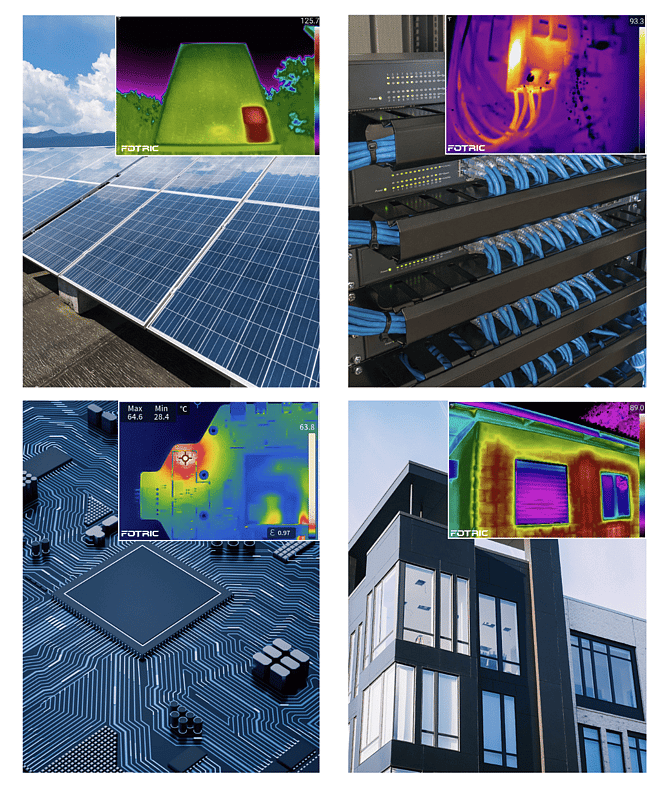
AECS now supplies the FOTRIC TK6 Kit Thermal Imaging Camera to New Zealand workshops — a true 384×288 sensor, precise manual focus, 40 mK sensitivity, and our team behind it. It joins the FOTRIC TD2e Acoustic Imaging Camera, which does the same job for sound.
Talk to us about which one fits your workshop, or arrange a demonstration.
0800 673 034 · sales@aecs.co.nz