Every summer the A/C work picks up. What's changing is the gas coming in with it. More cars rolling into NZ workshops now run R1234yf, the low-impact refrigerant that has replaced R134a in new cars across Europe and Japan. Across the Tasman, Australia is about to draw a hard line.
Here's where things stand, and what it means for your workshop.
Two gases, two very different futures
R134a has been the standard in vehicle air con since the 1990s, and most cars on NZ roads still run it. Its problem is its global warming potential (GWP): released into the air, a kilogram of it has the warming effect of more than 1,300 kilograms of CO2.
R1234yf does the same job with a GWP of under 1. Europe has required a refrigerant with a GWP below 150 in new vehicle types since 2011, which made R1234yf the default there. Japan set the same 150 target for new passenger cars from 2023, and big Chinese exporters such as BYD already charge their vehicles with R1234yf.
R1234yf is mildly flammable (safety class A2L), so it has its own handling rules and its own service equipment.
Australia: no new R134a cars from 2028 (proposed)
Australia's federal environment department released draft standards for consultation in September 2026. Under the draft:
From 1 January 2028, new passenger vehicles charged with a refrigerant of GWP 150 or more couldn't be imported. That rules out R134a.
The draft makes no distinction between new models and existing ones still in production.
Existing R134a cars can still be serviced, and bulk R134a can still be imported for that under the quota system.
Refrigerant has to be recovered during servicing, repair and dismantling, not vented.
R134a supply in Australia is already tightening. It now makes up about 36% of bulk HFC imports measured in CO2 terms, and every kilogram of it uses up 1,430 kilograms of an importer's quota. Industry speakers there expect R134a to keep getting harder to get and more expensive.
Consultation closed on 23 October. The rules aren't final yet, but the direction is clear.
New Zealand: heading the same way
New Zealand has been phasing down HFC imports since 1 January 2020, under the Kigali Amendment to the Montreal Protocol. R134a already carries the synthetic greenhouse gas levy.
A Ministry for the Environment consultation draft proposed phasing R134a out of vehicle air conditioning, with 2023 for new vehicles and 2028 for used imports. It pointed out that most of our vehicles are imported, so the timing depends largely on manufacturers in Japan and Korea. Check the Ministry's latest rules before relying on any date. Whatever the final timetable, the cars arriving from Japan, Europe and China are already moving to R1234yf.
And after R1234yf?
Some European makers, and some electric vehicles, use R744 (CO2). It runs at very high pressure (up to 130 bar) and needs dedicated service equipment and CO2 safety monitoring. It's still a small slice of the NZ fleet. For most NZ workshops, the next few years are about two gases: R134a and R1234yf.
What this means for your A/C bay
R134a work isn't going anywhere soon. Millions of cars on NZ roads run it, and they'll need regas, recovery and repair for years.
R1234yf work is growing every year. If you can't do it, those cars go down the road.
Keep the gases apart. Mixing refrigerants contaminates the system and the gas you recover. Australian industry surveys have found hydrocarbon contamination in around 3 to 4% of vehicles, and a contaminated charge can become flammable. The cleanest way to do both gases is one dedicated machine per gas.
Recover, don't vent. Recovery is the rule for both gases, and it's where a good machine pays its way.
Our answer: one machine for each gas
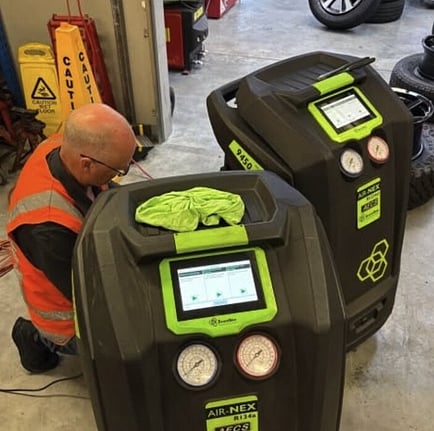
That's why we stock the Brain Bee AIR-NEX in two versions:
AIR-NEX 9350 for R134a
AIR-NEX 9450 for R1234yf
Both are fully automatic (recover, recycle and recharge), with UV dye injection, WiFi updates and remote support, and set-up, onboarding and support from the AECS Equipment team. Run them side by side and you're ready for whatever car comes in next.
In stock now in New Zealand. Got an old A/C machine? Trade it in, any brand. We'll make you an offer and put it towards a new AIR-NEX. Blackfern members can pay over 3, 6 or 12 months.
Call 0800 673 034, or see the AIR-NEX range.