
A Hilux comes in with the DPF light on. The owner says they've done the regen and it's back again a day later. Or the regen won't start at all. It's one of the most common diesel jobs in NZ workshops, and clearing the code is rarely the end of it.
A DPF that keeps filling is usually a symptom. Find what's making the soot, or what's stopping it burning off, and the regens look after themselves.
How the Hilux DPF is meant to work
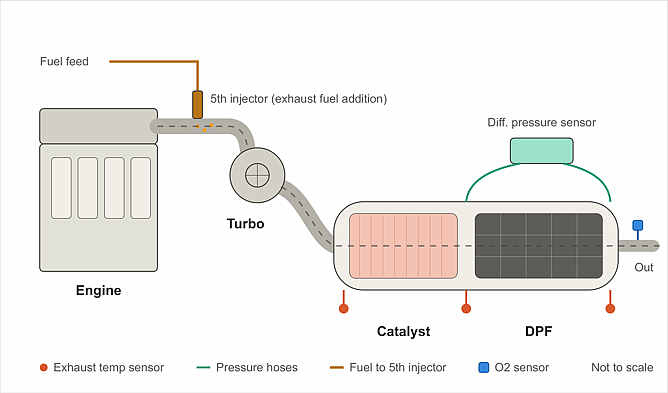
The 2.4 and 2.8 litre Hilux diesels (2GD-FTV and 1GD-FTV) arrived with the new-generation Hilux in late 2015, and DPF-equipped versions have a diesel particulate filter in the exhaust. Not every early variant in every market was built with one, so confirm what's on the vehicle in front of you. The filter traps soot. A differential pressure sensor measures how hard the exhaust is working to get through it, and when the reading climbs the engine control unit starts a regeneration.
To regenerate, the system raises exhaust temperature high enough to burn the soot to ash. The Hilux does this by adding a small amount of fuel into the exhaust through a separate exhaust fuel addition injector, a "fifth injector" in the exhaust ahead of the turbo and catalyst. The fuel burns in the catalyst, and the heat carries through into the filter.
Most regens happen on their own during steady driving at highway speed. You'll often never know one has happened. Hilux built from June 2018 also have a DPF switch on the dash so the driver can start one manually when the light asks for it, with the vehicle parked and the engine running. Toyota offered to retrofit the switch to many earlier vehicles.
Why it keeps filling up
Short trips. Town running never gets the exhaust hot enough for long enough. Regens start and get interrupted, and soot builds faster than it burns.
Wrong oil. Engines with a DPF need a low-ash (low-SAPS) oil to Toyota's specification. For the DPF-equipped 1GD-FTV and 2GD-FTV that's ACEA C2 in 0W-30 or 5W-30, such as Toyota Genuine 5W-30 PFE. Check the owner's manual for the year, as some later manuals also list C3. A standard high-ash diesel oil leaves ash in the filter, and ash doesn't burn out.
Air leaks after the air mass sensor. A split intercooler hose or a leaking intercooler means the engine gets less air than it thinks. It runs rich and makes more soot. On the Toyota Dyna job we wrote up, an oil-soaked intercooler was the root cause.
A blocked fuel addition injector. It sits in the exhaust and soot can cake around the nozzle. If fuel can't get to the catalyst, the regen can't get hot enough. This was one of the most-reported failures on early Hilux.
Sensors telling the wrong story. A differential pressure sensor with a split or blocked hose, or a lazy exhaust temperature sensor, can trigger regens the filter doesn't need, or stop the ones it does.
Engine faults upstream. Injector problems, EGR faults and boost leaks all make soot. Any stored engine code is worth chasing before you look at the DPF.
What to check first
Scan the whole vehicle, not just the engine. Note every stored code and the freeze frame before you clear anything.
Look at live data: PM Accumulation % or DPF differential pressure, exhaust temperatures, air mass flow and boost. Compare air mass at idle against what's expected.
Check the intake side. Intercooler, hoses and clamps, with a smoke test if you have one.
Check the differential pressure sensor hoses for splits, kinks and blockages.
Confirm the oil in the engine is the right specification, and that the level isn't rising. A rising level can mean fuel dilution from failed regens.
Check the fuel addition injector, with the scan tool's actuation test if the vehicle supports it, and by removing it and inspecting for soot build-up if not.
Check whether the vehicle has had Toyota's DPF updates (ECU reprogramming and related service work). On a 2015 to 2020 build, talk to a Toyota dealer before the customer pays for a filter (see below).
Check with Toyota before the customer pays
Toyota knows about DPF problems on these vehicles. This isn't a formal safety recall, but Toyota New Zealand has said publicly that it "will continue to provide any related repairs free of charge" for DPF issues. The fix Toyota has used includes a new DPF, an updated fuel addition injector and software changes. The vehicles involved are mainly Hilux, Fortuner and Prado with the 1GD-FTV or 2GD-FTV engine, built from late 2015 to around 2020.
If the customer's Hilux falls in that range, get them to contact a Toyota dealer with the VIN and service records before you quote for a new filter. Toyota decides who qualifies, and a regular service history with the right oil will help their case. If the vehicle doesn't qualify, or the DPF work has already been done and the problem is back, the causes above still apply.
Forcing a regeneration with a scan tool
Once the cause is fixed, a workshop can start a regeneration from a diagnostic scan tool. The tool lists the conditions the engine control unit wants before it will start, typically engine at operating temperature, vehicle stationary, no active faults that block the regen, and enough fuel in the tank. Follow the conditions your tool shows for that vehicle.
A few things to know before you start:
Make sure there are no active fault codes. The engine control unit won't carry out the burn while a code is active, so clear the codes once the fault is fixed and check that they show as stored (history), not current. If a code won't clear and stays current after the repair, disconnect the battery fully for 5 minutes, reconnect it and scan again. Be ready to reset the clock, radio and any one-touch windows afterwards.
The exhaust gets very hot. Do it outside or under extraction, well clear of anything that can burn, with the bonnet up and nobody near the tailpipe.
Expect the idle to rise (Toyota quotes around 1,200 rpm for a stationary regen) and the regen to take around 20 to 30 minutes, longer in cold weather or with a high PM Accumulation %. Don't touch the accelerator, gear lever or clutch while it runs.
If the PM Accumulation % is too high, the control unit may refuse a regen to protect the filter. That's when the filter needs to come off for cleaning or replacement.
A forced regen with the cause still there just buys a few days. The next one fails and the customer is back.
What about removing the DPF?
It gets asked. The Land Transport Rule: Vehicle Exhaust Emissions 2007 bans removing or tampering with emissions control equipment on a NZ-registered vehicle where it would adversely affect the vehicle's emissions. Pulling the DPF, or fitting a "delete" module to hide it, falls under that. It's a problem at WoF time and when the vehicle is sold. Fix the cause and keep the filter.
Equipment for this job
A diagnostic scan tool with DPF service functions: see our car diagnostic scan tools.
Launch SLD-501 smoke machine to find leaks in the intake, boost hoses and exhaust.
Fotric TD2e acoustic imaging camera to pinpoint boost, vacuum and air leaks by sound, with the engine running.
Other workshop tools may be needed for the repair, depending on what you find. For the diagnosis itself, a scan tool and a few spanners will get you most of the way.
Stuck on a fault? Call our tech team on 0800 673 034.
FAQs
Why does my Hilux DPF light keep coming back?
Usually because something is making more soot than the filter can burn off, or stopping regens from finishing. Short trips, the wrong oil, air leaks after the air mass sensor and a blocked fuel addition injector are the common causes.
Can I drive while the DPF is regenerating?
Yes. A regen that starts while driving should be allowed to finish, so keep driving at a steady speed rather than switching off. Stopping part way is one of the most common reasons regens fail. A manual regen started with the dash switch is different: the vehicle has to stay parked with the engine idling until it finishes.
Can a workshop force a DPF regeneration?
Yes, with a diagnostic scan tool that supports the Hilux DPF service function, once the cause of the soot build-up has been found and fixed.
How long does a Hilux DPF regeneration take?
A stationary regen usually takes about 20 to 30 minutes, with the idle raised to around 1,200 rpm. It can run longer in cold weather or when the PM Accumulation % is high. The DPF light goes out and the idle drops back to normal when it's finished.