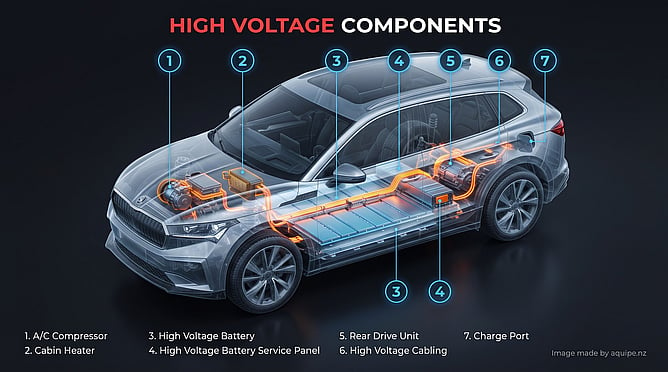
An EV comes in for a WoF. It's four years old, the air con has never been serviced, and the owner mentions that fast charging feels slower than it used to. Most people would look at the battery. On a lot of EVs, the first place to look is the air con.
We've been making the case for regular A/C servicing for a while: it's billable work, it keeps customers comfortable and it heads off an expensive compressor failure. On electric and hybrid vehicles the stakes are higher. The same system that cools the cabin often cools the high-voltage battery, so a skipped service can cost far more than a compressor.
Why it matters now
Plug-in vehicles made up 27.9% of New Zealand's new passenger market in the first eight months of 2026, up from 12.3% a year earlier (Motor Industry Association figures). Most of the newer brands service only in the main centres, so a growing share of these cars will come to independent workshops, especially once they're out of warranty.
On most liquid-cooled EVs a battery chiller hands heat from the battery to the refrigerant circuit, and the battery management system runs the compressor whatever the cabin setting. Some designs go further and cool the battery with refrigerant directly; BYD has confirmed this for its Atto 1. On those vehicles a low charge, a leak or a failed valve isn't a comfort complaint. It's a battery-cooling fault.
The manufacturers say so
Porsche 911 GTS T-Hybrid (2025–26), workshop manual SY 119/25: a leaking seal at a refrigerant-line joint brings up the warning "High-voltage battery cooling malfunctioning", with refrigerant-pressure-too-low codes B16A284 and P053400. Porsche recommends a nitrogen or forming-gas leak test.
GM and a US EV specialist, quoted by InsideEVs: when a refrigerant leak is detected, the car limits hard acceleration or DC fast charging to protect the battery.
An EV that charges slowly or warns about battery cooling may need an A/C diagnosis, not a battery one.
What a skipped A/C service costs on an EV
Every A/C system loses refrigerant. Hoses, O-rings and seals let a little escape all the time. European type approval allows a new car's system to lose up to 40 g a year (60 g with a second evaporator), and many systems now hold as little as about 450 g in total. In a conventional car the driver may not notice a loss of cooling until up to two-thirds of the charge has gone, which is why we recommend a service every two years.
On an EV, the battery notices before the driver does. An FCA service case (STAR S2324000014, 2023) traces warm A/C and fault code P1DBA "Battery Cooling System Failure" to nothing more than a low refrigerant charge. When cooling falls short, the battery management system slows charging to protect the pack. That's the cost of an unserviced system while it still works: slower charging now, and a hotter, faster-ageing battery over time.
Then the compressor, then the battery
An EV's electric scroll compressor has its motor built in, and DENSO says that motor "is cooled with a mix of refrigerant and (POE) oil", an oil that must also insulate the high-voltage windings. As the charge falls, less refrigerant flows to carry heat out of the motor, and the compressor keeps running whenever the battery needs cooling, including while it charges.
When a compressor fails, its debris travels. On the BMW i3 the battery cooling circuit sits inside the battery enclosure, and debris from a failed compressor has led to repair bills that write the car off. With the battery making up an estimated 30–50% of an EV's value (Taylor Fry), the gap between a two-yearly service and a write-off is one neglected system.
And the fire risk
A lithium-ion battery fire starts with heat. The cooling system is the battery's first line of defence, and the battery management system is the backstop. An A/C system left to leak down for years leaves the car running on its backstop. Fluid loss of any kind on a high-voltage vehicle is a diagnosis, not a top-up.
On a petrol car a skipped A/C service costs a compressor. On an EV it can cost the battery.
Doing it right matters too
Electric compressors run their motor windings in non-conductive POE oil. An International/IC Bus EV service bulletin (2025) warns that as little as 1% standard PAG oil can reduce its dielectric properties, and Kia says PAG "would permanently damage the electric A/C compressor". A shared machine is the usual way it gets in. Toyota and Lexus ban A/C stop leak outright.
Don't forget the hybrids
Toyota and Lexus hybrids, including the Aqua, Prius and Corolla, cool the hybrid battery with cabin air drawn through a fan and intake. Toyota bulletin T-SB-0074-20 covers codes P0A80 and P0A7F caused by dust and debris in the battery cooling fan or intake, and warns against cleaning the fan in place, because debris drops into the battery case. Hyundai and Kia hybrids work the same way.
Battery intake and fan cleaning is billable work that sits alongside an A/C service.
The Equipment
Brain Bee Clima AIR-NEX 9380 (R134a) and 9480 (R1234yf): the top of the range, with a separate circuit for POE oil and POE UV dye on board. Built for workshops that move between EVs and conventional cars all day, without PAG reaching an electric compressor.
AIR-NEX 9350 (R134a) and 9450 (R1234yf): add the Hybrid Pro Kit for Hybrid Function to switch safely between PAG and POE oils for hybrid and EV work.
Mini ID refrigerant identifiers, R134a and R1234yf: hand-held, with a PASS or FAIL result. They flag illegal blends, propane, butane and excess air before the gas reaches your station.
Every AIR-NEX handles pure R134a or R1234yf only. Some European EVs, including Volkswagen ID models with a heat pump, use high-pressure R744, so read the under-bonnet label first.
Leak detection
FOTRIC TD2e acoustic imaging camera: a 64-microphone array shows a leak's ultrasonic noise (2–100 kHz) as a heat map over the image, without contact or dismantling.
CPS Leak Seeker LS1: electronic leak detector for R134a and R1234yf, sensitive to 3 g a year, well under the 40 g a year a new car is allowed to lose. It also picks up 95/5 nitrogen-hydrogen trace gas for OEM forming-gas tests.
Brain Bee UV Leak Detector Kit: UV lamp, goggles, fluorescent dye and dye-removing spray.
Nitrogen Leak Test Kit: pressure-test the system at normal operating pressure without losing refrigerant.
Worked example
Back to that four-year-old EV. The station recovers well under the specified charge, the TD2e finds a weeping joint, and after the repair and a POE recharge the battery has its full cooling back. Billable today, and booked in every two years.
FAQs
Does every EV cool its battery with the A/C?
Not every one, but most liquid-cooled EVs use a chiller that hands battery heat to the refrigerant circuit, and some (like the BYD Atto 1) cool the battery with refrigerant directly. Check the service information for the model.
Can I use my existing A/C machine on an EV?
Only if it can keep PAG out of the electric compressor. As little as 1% PAG can reduce the insulating properties of POE oil. The AIR-NEX 9380 and 9480 have a separate POE circuit; the 9350 and 9450 need the Hybrid Pro Kit.
How often should an EV's A/C be serviced?
We recommend every two years, the same as a conventional car, but on an EV the battery feels a low charge before the driver does.
Can I use stop leak?
No. Toyota and Lexus ban it outright, and on a high-voltage vehicle a leak is a diagnosis, not a top-up.
Talk to us about AIR-NEX stations and leak detection for EV and hybrid work: 0800 673 034 or sales@aecs.co.nz.