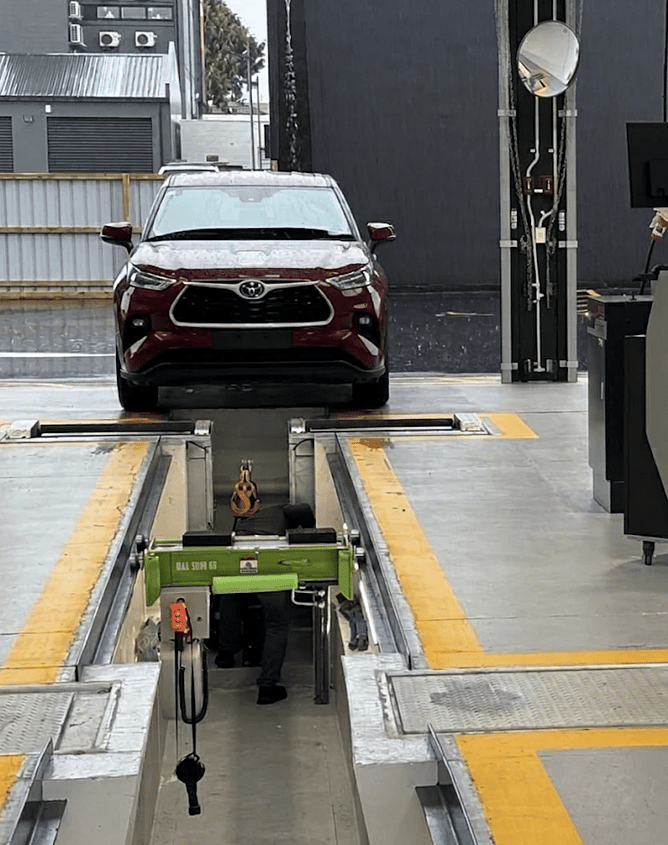
An electric vehicle comes in for its WoF. You can take it out on the road with a decelerometer, get up to 30 km/h and stand on the brakes. Or you can drive it onto the rollers in your own workshop and test each wheel.
Both are accepted for a WoF. They don't tell you the same thing, and on an EV the difference matters.
Why EV brakes need a closer look
On an EV the drive motor does most of the everyday slowing through regenerative braking. The friction brakes get very little use. Rotors can go days or weeks without real pad contact and build surface rust, and calipers can seize. A new EV may also have sat through shipping and time in a dealer's yard before its first test.
So the brakes most likely to have a hidden fault are the ones the driver hardly ever uses. The test needs to find that.
What a decelerometer shows you
One figure: how hard the whole vehicle slowed down. It can't show what each wheel did, and the VIRM also fails a vehicle whose brake balance varies by more than 20% between wheels on the same axle.
On an EV there's a further catch. Regen is designed to slow the vehicle on the road. It's why the international inspection body CITA recommends checking regen on a test drive, where it "must noticeably decelerate the vehicle". In a stop from 30 km/h, the figure you read can be the motor and the friction brakes together. It can't tell you how the pads and rotors are doing on their own.
And the test needs a level strip and a hard stop from 30 km/h. For many workshops that means the public road, in traffic and whatever the weather is doing, in a customer's vehicle that is heavy and close to silent.
What a roller brake tester shows you
The vehicle stays on site, under cover, at walking pace. The tester measures each wheel separately:
Drag before you touch the pedal, from a sticking caliper or seized piston.
Ovality, when you select it.
Brake force and efficiency for each axle.
Balance, as a measured figure, not a feel through the steering wheel.
Those are the faults an EV is prone to.
At the end you have a shareable report with brake force and balance, and the graphs, to show the customer and keep with the job. A full test lane adds side slip and suspension testing, so the running gear is checked in one pass without leaving the workshop.
What we found
We tested a range of new EVs, before any changes were made to their regen settings. On the rollers they showed brake imbalance and performance issues. The same vehicles passed on a decelerometer test.
Testing an EV on the rollers
An EV doesn't behave exactly like a petrol or diesel vehicle on a brake tester, and there's no EV-specific procedure in NZTA's VIRM yet. Its bulletin on brake test procedures for specific vehicles says to check with the manufacturer's local agent if you're not sure, and that the brake machine's supplier may also help.
Every EV is different. Always check the manufacturer's specifications and test procedure for the vehicle in front of you.
Check for a test mode first. Before the vehicle goes on the rollers, find out whether the manufacturer provides either of these:
A roller brake test mode. Some vehicles have one, sometimes in a service menu reached with a scan tool, to stop the stability and traction control reading the rollers as wheel slip. Some manufacturers publish a roller test procedure. Tesla, for example, publishes one for UK MOT testing.
A setting that switches regen off or turns it down. Many EVs let you choose a lower regen level. Some can't switch regen off completely, even in Neutral.
Car wash mode isn't either of these. It's built for car washes, and no manufacturer we found documents it as a brake test setting.
Before you start:
Single motor or dual motor? Dual-motor and all-wheel-drive EVs can push torque to the axle that isn't on the rollers. Treat them like any permanent 4WD and select the tester's 4WD mode.
Set the test mode or regen setting you found, if there is one.
Look the vehicle over. Warning lights, damage, a burning smell or a swollen battery pack mean stop.
Follow the manufacturer's test process when applying the brakes: an even, steady application through to the end of the test.
What you might see:
An imbalance with no mechanical cause. The vehicle blends regen and friction braking electronically, and the split isn't always even side to side. Check pads and rotors first, then repeat the test.
Readings that change from run to run. The electronics reacting differently each time, or a rusty rotor. Repeat with an even, steady application and inspect the rotors.
A lurch, a warning light or a fault code. Traction or stability control has read the rollers as wheel slip. Stop and recheck the mode.
Grinding on the first application. Surface rust. It often clears after a few applications, so check for pitting.
Stay clear of the wheel arches while the wheels are turning. An EV gives no engine noise to tell you the drivetrain is live.
If the EV won't cooperate
If a vehicle reacts badly on the rollers more than once, don't force it. For a WoF an NZTA-approved electronic decelerometer is an accepted test, and for a CoF A the VIRM allows one where a vehicle can't reasonably be tested on the brake machine.
That makes the decelerometer the fallback. It gives you the least information about the brakes, so it's the last choice for the vehicles whose brakes most need a proper look.
Equipment for this job
AECS Equipment supplies, installs and calibrates NZTA-approved light vehicle brake testers and test lanes from Cosber and VTEQ.
Cosber brake tester: Car Brake Tester STT10E
Cosber full test lane, with suspension and side slip: Car Test Lane STT10E
VTEQ brake tester: VTEQ 3010 Light Vehicle Brake Tester
VTEQ full test lane, the 3080: VTEQ brake testers
Still road testing with a decelerometer, or got an EV that won't behave on your rollers? Call our team on 0800 673 034.
FAQs
Is a decelerometer test enough for an EV's WoF?
It's an accepted WoF brake test. It gives one overall figure from a road run, with the motor's regen potentially included, and nothing per wheel. A roller brake tester shows what each friction brake is doing.
Can you test an electric vehicle on a roller brake tester?
Yes. Almost every passenger EV is a light vehicle and is tested with the same approved equipment as any other. Check for a roller test mode or regen setting first, and use the tester's 4WD mode for dual-motor models.
Does regenerative braking affect a roller brake test?
It can. The vehicle blends regen and friction braking electronically, and that can show up as an imbalance or as readings that change from run to run. Check for a roller test mode or a setting that turns regen down before you start, and check the manufacturer's specifications.
Why are the brakes on a nearly new EV rusty?
Regen does most of the braking, so the rotors see little pad contact. Add weeks of shipping and time in stock, and surface rust is common.